I buddy-read Wide Sargasso Sea with La La in the Library, who’s also a big fan of Jane Eyre. I have joined her on the annual Jane Eyre re-read for the past 3 years racking my Jane Eyre reads up to a total of 4! We’ve had some really good conversations about it, dug out some really interesting information, so naturally we simply had to read Wide Sargasso Sea.
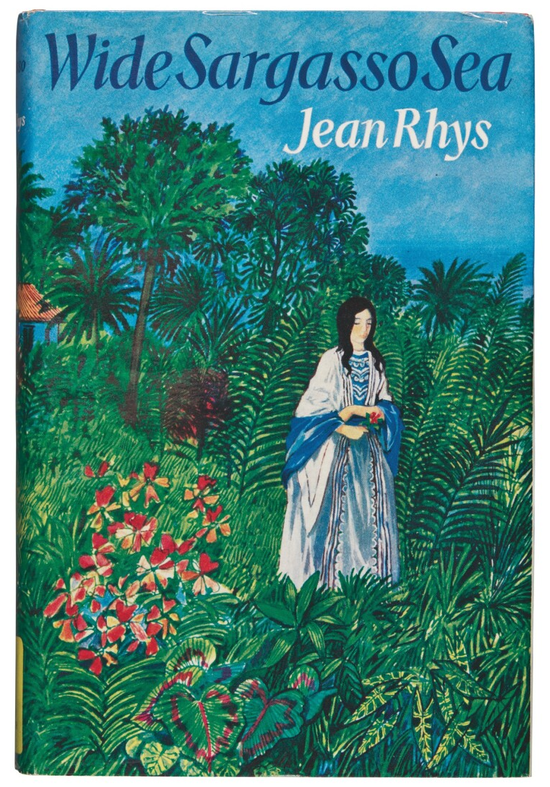
Wide Sargasso Sea is a 1966 novel by Dominica-born British author Jean Rhys. It is a feminist and anti-colonial response to Charlotte Brontë’s novel Jane Eyre, describing the background to Mr. Rochester’s marriage from the point-of-view of his mad wife Antoinette Cosway, a Creole heiress.
I can appreciate why Wide Sargasso Sea is considered an important novel, but I ultimately came away more frustrated and disappointed than impressed. I would also like to link LaLa’s Goodreads review here, right before my own rambling.
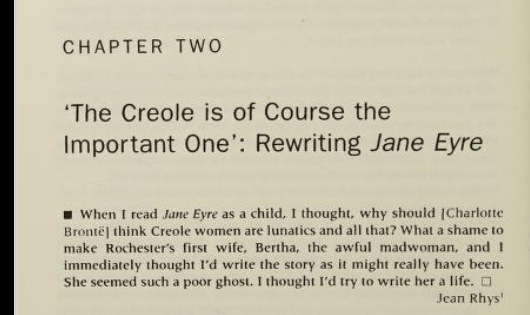
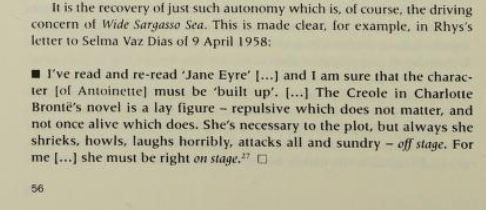
Before anything else, I need to say this: Wide Sargasso Sea is not a prequel to Jane Eyre. Yes, it takes place before the events of Brontë’s novel, but that doesn’t make it the missing first half of the story. Jean Rhys wasn’t filling in gaps left by Charlotte Brontë, she was responding to Jane Eyre with a story shaped by her own convictions and grievances. Rhys herself was open about her discomfort with Brontë’s portrayal of Bertha Mason, the white Creole “madwoman in the attic.” She wanted to give that woman (particularly because it was a Creole woman) a life before madness, to bring an offstage character to centre stage. I don’t object to that idea at all. In fact, it’s an intriguing premise. What I do object to is the price paid for it.
The strongest aspect of the novel – for me – is undoubtedly Rhys’s writing. Her descriptions of the Caribbean are vivid and lush. She succeeded in delivering the oppressive heat and overwhelming vegetation. The narration often rambles, but for the story that it is, the rambling suits the tone. It creates a sense of uncertainty and emotional instability that fits the story and pulls a reader into the heat-induced madness no one can escape. I also found the collapse of Antoinette and Rochester’s marriage entirely believable. Their cultural backgrounds, personalities, and personal expectations set the relationship on the course of doom. Then again, when did arranged marriages ever really, truly work?!
All that said…
The Rochester in Wide Sargasso Sea is not Charlotte Brontë’s Edward Rochester.
This is Jean Rhys’s Rochester.
Rhys presents him as weak, greedy, emotionally abusive, and increasingly cruel to allow Bertha to have her moment “on stage”, and my issue is, that so many readers now treat Rhys’s portrayal as though it reveals the “truth” about Rochester in Jane Eyre. It doesn’t. It reflects Rhys’s interpretation, one shaped by her desire to reclaim Antoinette’s story.
People often claim that Wide Sargasso Sea faithfully connects to Jane Eyre, but excuse you!, it so does not! It borrows the framework while taking considerable liberties with characterisation and motivation. Yes, sure, that’s perfectly acceptable for a literary response, but it also means it cannot be accepted as a genuine prequel. The two novels are as much disconnected as they are connected.
I’ll grant that Brontë’s Rochester is not blameless material to begin with. Unfortunately, he does keep his first marriage a secret in Jane Eyre. That hardly makes him the shadiest of characters in literature. And yes, Brontë does leave room to read in between the lines. We’re never given Bertha’s perspective in Jane Eyre, and her condition is described only through Rochester’s own account. Rhys is not inventing tension from nothing. She’s working with ambiguities that were already there. But!…
Ambiguity is not a verdict, and choosing to resolve it in the most damning possible direction is still a choice. Because let’s, for a second, consider Rochester’s actual alternatives. This was Victorian England, when a woman diagnosed as “mad” was typically committed to an asylum (often for lesser things than actually having mental health issues), and those institutions were, by most historical accounts, brutal places. So, keeping that in mind, Rochester’s decision to keep Bertha at home, attended by a 1:1 caretaker rather than handed over to an institution, could be read as the more humane option available to him at the time, not proof of cruelty.
As a side note: there was this undergraduate honors thesis by Jordan L. Frederick (2010), which explores how the Brontë sisters used madness and asylums as narrative tools. You can find it here: LINK The thesis looks at the elements the sisters use in their books (Villette, Wuthering Heights, The Tenant of Wildfell Hall) and how through these elements the sisters critique the gender power struggles of Victorian era society. So, no, Charlotte Brontë didn’t create Bertha to be invisible. Bertha had a bigger and more important role in the novel than Rhys gave credit for.
The Rochester in Jane Eyre is not mentally or physically abusive, as Rhys makes him to be in Wide Sargasso Sea. And perhaps what saddens me most is that readers who encounter Wide Sargasso Sea first often go into Jane Eyre already convinced that Edward Rochester is irredeemably horrible. That impression is biased by Rhys’s reinterpretation. Meaning, a reader’s understanding and experience of Jane Eyre is already biased. I know every reader is entitled to their own perspective. If someone reads Jane Eyre and dislikes Rochester, that’s entirely their own choice. But if that opinion rests primarily on Wide Sargasso Sea, then I think Brontë’s Rochester is being judged through a lens that was never hers.
In the end, I admired Rhys’s prose far more than I admired the novel itself. Rhys’s Rochester serves Rhys’s narrative purposes only. His greed, his coldness, his weakness are all dialed up to make Antoinette’s suffering plausible, but that also means he exists to be a villain first and a person second. And it’s not at all what Rochester is like in Jane Eyre. Yes, whilst the atmosphere is haunting, the setting unforgettable, and Antoinette a compelling, tempting character, I simply hate the book’s treatment of Rochester, or its reputation as “the story before Jane Eyre”. For me, Wide Sargasso Sea works best as what it actually is: one writer’s reinterpretation of another’s work. A fan-fiction fuelled by some personal grievance over the fact that an off-the-page Creole woman was crazy. Yup. I stand by my words – it’s not a prequel. Not the missing history. Simply Rhys’s version of events. A version that I cannot fully embrace.


Wonderful review! I haven’t read Jane Eyre for decades, and your review definitely makes me want to, especially as I bought the audiobook years ago and still haven’t listened to it! 😳
LikeLiked by 1 person
Thank you! 🙂 Oh, I promise once you start with Jane Eyre, you’ll be through it in no time. Such a great book. Have you read Wide Sargasso sea, as well?
LikeLiked by 1 person
No, I remember it being published, but haven’t read it.
LikeLiked by 1 person
Yeah… it was interesting, but… it didn’t totally work for me, either.
LikeLiked by 1 person
Glad we’re on the same wavelength 🙂
LikeLike